SkillSurf · IHP SG13G2 · SkyWater SKY130
The Art of Analog IC Design
An open-source course in analog CMOS integrated-circuit design, from the transistor to tape-out. Every circuit is designed, simulated and laid out with free tools in two open 130 nm processes, side by side.
Analog circuits connect every chip to the physical world, and until recently designing them meant expensive licences and process data locked behind non-disclosure agreements. That has changed: open process design kits from IHP and SkyWater, and open-source tools such as Xschem, ngspice, KLayout, Magic and Netgen, now cover the whole flow from schematic to GDS, and open shuttles fabricate student designs.
This course teaches analog IC design on that open stack. It follows one method throughout: a short derivation, a hand calculation, then a simulation in both PDKs, with a what this means for your design box to close each idea. Every plot is generated from the PDKs’ own transistor models by scripts in this repository, so you can reproduce, change and extend them.
What is inside
Getting started
Why analog, the analog design flow, the IIC-OSIC-TOOLS container, and the SG13G2 and SKY130 processes.
The transistor
MOSFET operation in every region, small-signal models and device characterization, and gm/ID sizing with lookup tables.
Building blocks
Single-transistor stages, current mirrors and bias references, frequency response, and the differential pair and 5T OTA.
Amplifier design
Feedback and stability, the two-stage Miller OTA course project, noise and mismatch, bandgap references and LDOs.
From schematic to silicon
Analog layout, DRC, LVS and post-layout simulation, fabrication and open tape-out routes.
Mixed-signal circuits
Advanced topics: switched-capacitor circuits, sample-and-hold circuits, comparators, data converters, and VCOs and phase-locked loops.
The art of analog layout
Layers and rules, reliability, resistors, capacitors, matching, bipolar devices, power devices and ESD, and assembling a die, drawn in both PDKs.
Reference
Formula sheet, PDK quick reference, ngspice and Xschem cheat sheet, and a glossary.
Two PDKs, side by side
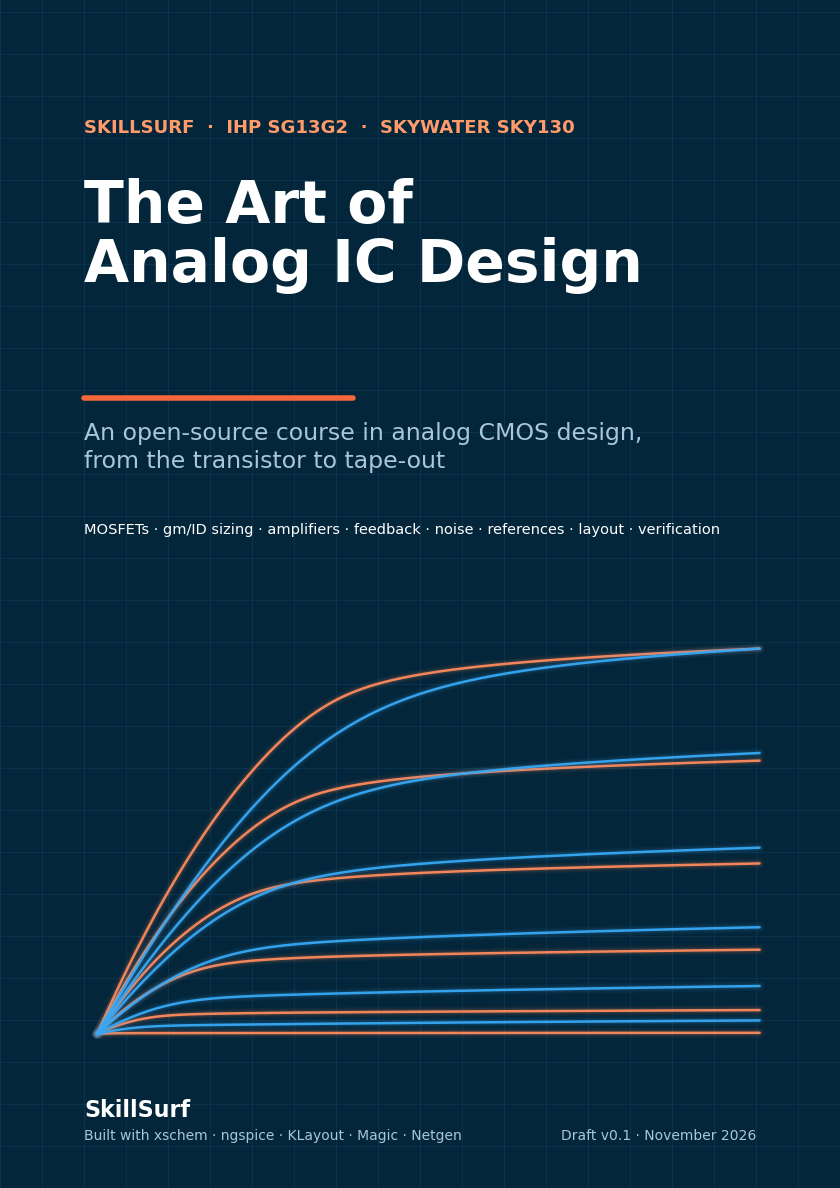
Every example is worked in IHP SG13G2 (1.2 V core devices, PSP compact models) and SkyWater SKY130 (1.8 V core devices, BSIM4 models). Netlists and code come in tabs: pick your PDK once and every page follows your choice. Plots show both, in the same two colours throughout: blue for SG13G2 and amber for SKY130. Seeing the same circuit size out differently in two processes is the best way to learn what is physics and what is just a number.
The course project
Parts III and IV build up to a two-stage Miller-compensated OTA with its own bias reference, designed to one specification in both PDKs, verified across process corners and temperature, and then laid out and verified in Part V. The labs take you through it step by step.
About
The course is written by SkillSurf, building on the 2025 Art of Analog CMOS IC Design workshop run with alumni of the Department of Electronic and Telecommunication Engineering, University of Moratuwa (workshop archive). Its scope and sequence draw on Prof. Sam Palermo’s ECEN 474 course at Texas A&M, Prof. Harald Pretl’s analog circuit design course at JKU Linz, the IHP Analog Academy, Prof. Boris Murmann’s open gm/ID material and Kwantae Kim’s open-source tool guides. All text and figures are original; every source is listed on the References page.
How this course was made. It was developed with the help of AI tools. The text, figures and code are reviewed by the authors, but errors may remain. If you spot one, please tell us through SkillSurf or email skillsurfedu@gmail.com, and we will correct it.
This is a living draft (v0.1, November 2026). Corrections and suggestions are welcome.